
Language is Infrastructure.
In the Inference Economy, AI models do not 'find' your content—they manufacture answers from it. Linguistic Engineering is the operating model for ensuring your corporate truth is retrievable, citable, and resilient.
The Shift from Search to Inference
The shift from Search to Inference requires a shift from Creative to Engineering.
SEO
GEO
Generative Engine Optimization
Prose
Semantic Triples
Subject-Predicate-Object structures
Persuasion
Probabilistic Fidelity
Maximizing retrieval accuracy
Linguistic Engineering: When Communications Became a Science
The fundamental shift from intuition-driven craft to evidence-based engineering discipline.
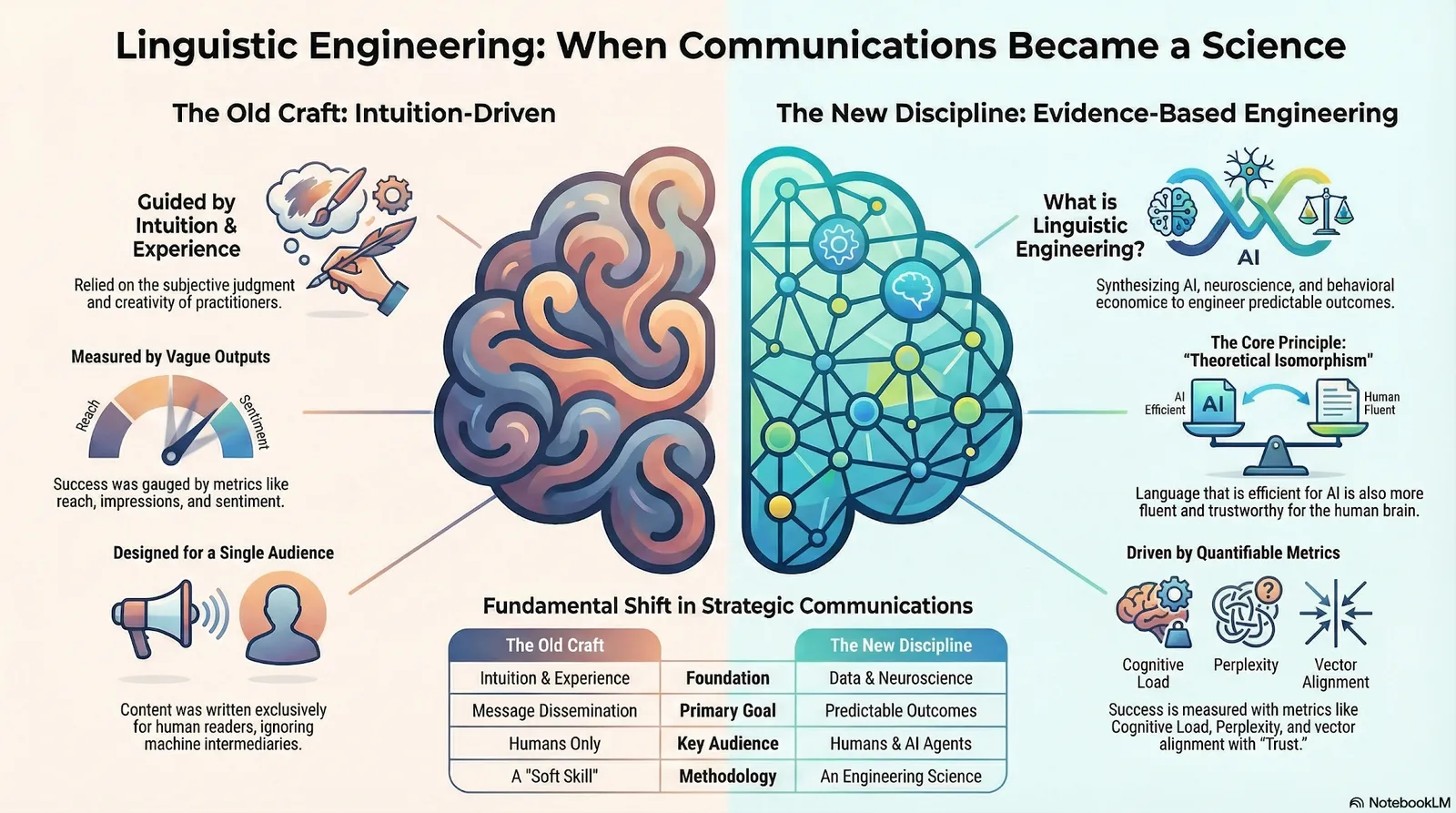
The old craft relied on subjective judgment and vague outputs like reach and sentiment. The new discipline synthesizes AI, neuroscience, and behavioral economics to engineer predictable outcomes measured by quantifiable metrics like Cognitive Load, Perplexity, and Vector Alignment.
The 4-Layer Architecture
The Semantic Supply Chain operates across four nested layers. Each layer introduces transformation risk.

Truth
Verifiable claims, source attribution, evidence chains
Generation
How language is produced—human, AI-assisted, or synthetic
Governance
Protocols for consistency, compliance, and traceability
Experience
Where meaning reaches the human decision-maker
The 3-Step Execution Loop
The daily operational cycle for moving information through the supply chain
Audit
Entropy Reduction
Reduce "signal noise" using the Cognitive Load Index (CLI) so content penetrates filter bubbles and survives AI compression.
Align
Vector Geometry
Structure information as semantic triples (subject-predicate-object) for AI distribution and retrieval.
Verify
Human-in-the-Loop
Anchor truth with the "Verified Human" as the source of authority in a synthetic world.
Why This Matters for CCOs
Traditional communication strategies optimize for human readers. This framework optimizes for the entire supply chain—from human author to AI gatekeeper to human decision-maker.
When a significant portion of organizational communications pass through AI systems—whether regulatory submissions, investor decks, or crisis responses—the quality of language infrastructure determines whether messages survive with fidelity.
Organizations that master the Semantic Supply Chain don't just "communicate better"—they build institutional credibility that scales trust, reduces risk, and survives the AI-mediated future.